
< Back to Blog overview
What is often missed when discussing process metallurgy at the bench scale is how dependent these workflows are on something as deceptively simple as mechanical agitation. Chemistry only delivers high yields if the slurry behaves correctly and slurry behavior is dictated by the overhead stirrer driving it. This article summarizes the published process, then explains why a properly specified digital overhead stirrer is foundational to reproducing this kind of result in your laboratory.
Optimized process parameters:
• Complex salt composition — Lepidolite : Na₂SO₄ : CaCl₂ : CaCO₃ = 1 : 0.5 : 0.3 : 0.05 (by mass)
• Roasting — 900 °C for 60 min in a muffle furnace
• Grind — roasted product reduced to < 74 µm (200 mesh)
• Water leaching — 60 °C, 60 min, liquid-to-solid ratio 3:1 mL/g, continuous mechanical stirring at 300 rpm
Reported recoveries under optimal conditions:
• Li₂O — 94.60%
• Rb₂O — 83.33%
• Cs₂O — 82.95%
• High solids density — At a 3:1 L/S ratio, the slurry is roughly 25 vol% solids of silicate-density particles (~2.6 g/cm³). Without continuous agitation, sedimentation is rapid and severe.
• Variable rheology — The slurry viscosity changes during the run as soluble phases (albite, residual sodium salts) dissolve and the residue restructures. Stirrer torque must hold a setpoint speed across this drift.
• Mass-transfer limitation — The leaching kinetics in Gu et al. show a rapid initial rise (10–30 min) followed by leveling; this is classic film-diffusion-controlled behavior. Adequate stirring renews the boundary layer at each particle surface, which is the entire reason the published 300 rpm setpoint exists.
A magnetic stirrer is unsuitable for this duty for several reasons: the abrasive ground-silicate particles will erode a PTFE-coated stir bar; the bar will decouple from the drive magnet at the densities involved; and there is no torque feedback to confirm that homogeneity is being maintained. A digital overhead stirrer with a properly selected impeller solves all three problems simultaneously.
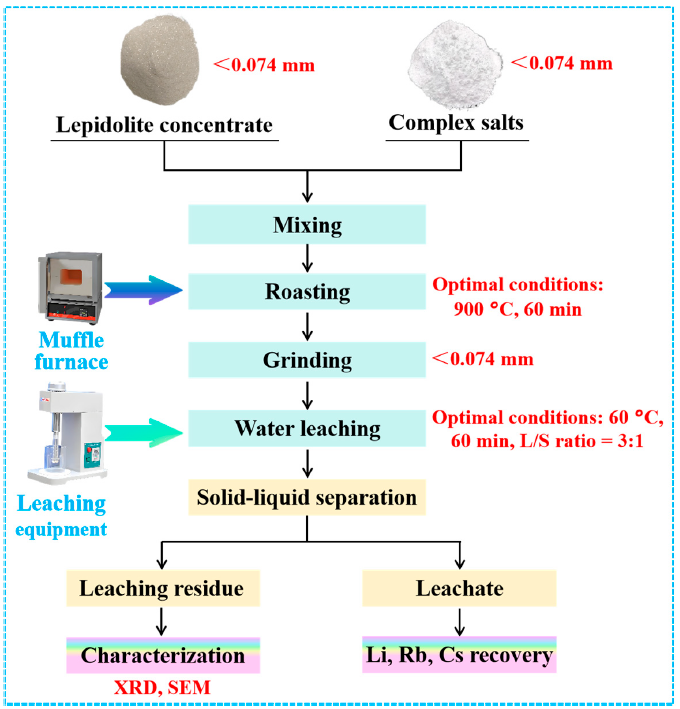 * Figure 1 : An experimental flowchart of the complex salt roasting–water leaching process for lithium extraction from lepidolite.
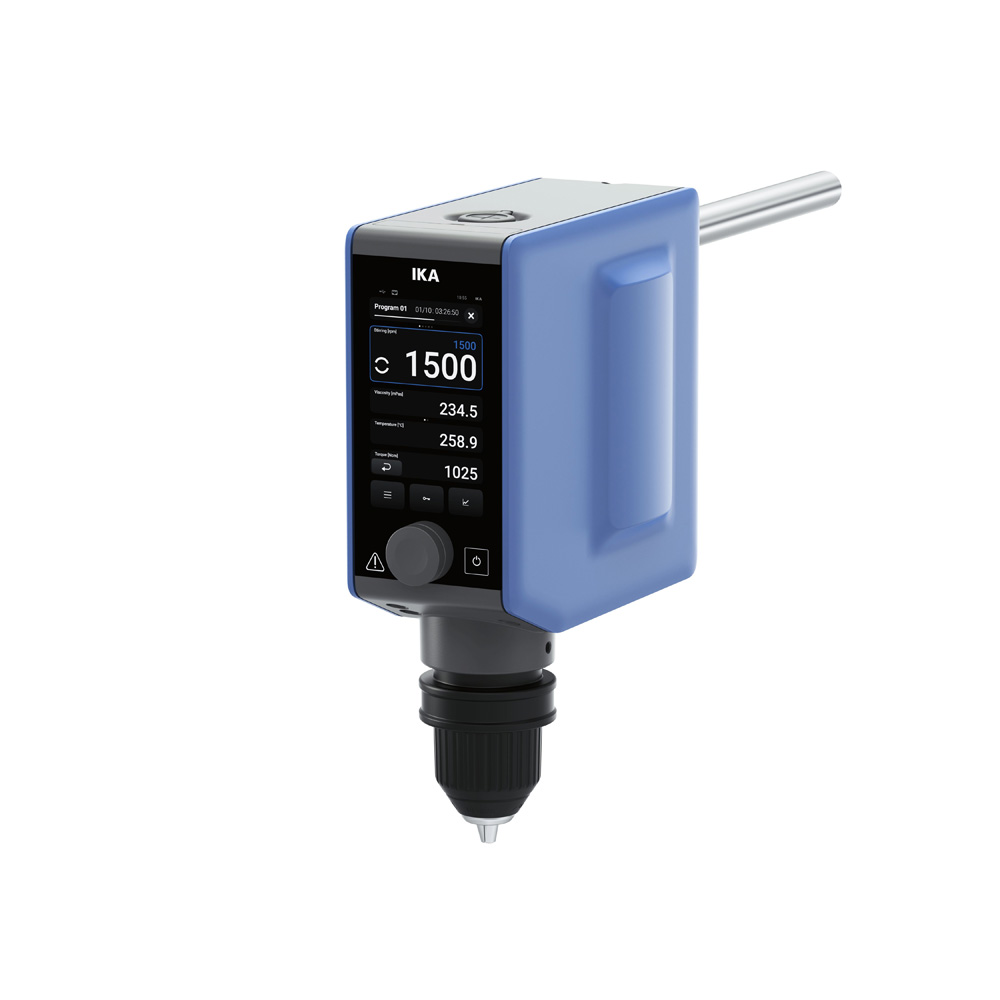
IKA's EUROSTAR series of digital overhead stirrers is purpose-built for exactly this duty:
• Maintenance-free brushless DC motor — no carbon-brush wear in long-duration leaching runs
• True torque display — confirm slurry homogeneity in real time and flag settling or thickening
• Wide speed range (30–2000 rpm on EUROSTAR 60 digital; 30–600 rpm on EUROSTAR 100 digital) — covers gentle suspension through aggressive mass-transfer duty
• Sealed housing — resistant to acid mist and salt aerosols that are routine in hydrometallurgy
• Full IKA R 13xx impeller ecosystem — propellers, dissolving discs, anchors, and tangential-style stirrers for any slurry rheology
For laboratories building out a lepidolite-to-lithium workflow or any analogous slurry-leaching workflow for spodumene, zinnwaldite, or recycled black-mass material, IKA provides the complete benchtop solution: an EUROSTAR digital overhead stirrer, the matched R 13xx impeller, an R 2722 and R 2723 series stand for heavy-duty mounting, and an HRC 2 circulator to hold the 60 °C leaching temperature precisely.
Find more information on the full IKA overhead stirrer range and accessories at www.ika.com or contact your IKA product specialist to discuss a configuration tailored to your critical-minerals research program.
* Reference
- Gu, J.; Liang, B.; Luo, X.; Yuan, W.; Xiao, B.; Tang, X. Systematic Optimization of Complex Salt Roasting and Leaching Conditions for Efficient Extraction of Lithium, Rubidium and Cesium from Lepidolite. Molecules 2025, 30, 2244. click
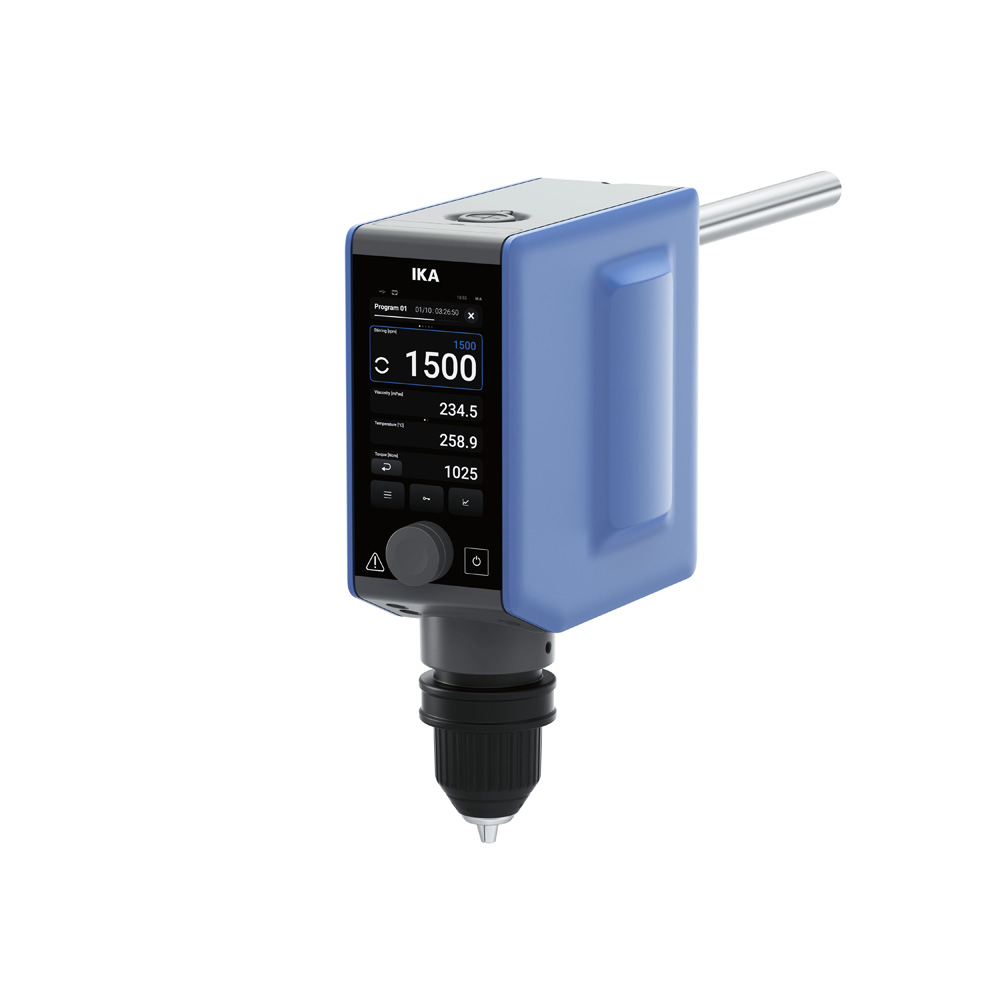
EUROSTAR Overhead Stirrer series
Related Products
Slurry Leaching of Lepidolite for Lithium, Rubidium, and Cesium Recovery: Why Reliable Overhead Stirring Is the Foundation of Critical-Mineral Hydrometallurgy
Critical Minerals Demand and the Push to Unlock Lepidolite
Global demand for lithium-ion batteries continues to outpace traditional brine and spodumene supply chains. Forecasts for lithium-carbonate demand growth of roughly 10% per year and lithium-hydroxide demand growth approaching 15% per year are forcing the research community to evaluate alternative lithium-bearing minerals. Lepidolite, a lithium-rich mica, is one of the most promising of these alternatives, and a recent peer-reviewed study published in Molecules (2025) presents an optimized process for recovering not only lithium but also the strategic rare alkali metals rubidium and cesium from this mineral.What is often missed when discussing process metallurgy at the bench scale is how dependent these workflows are on something as deceptively simple as mechanical agitation. Chemistry only delivers high yields if the slurry behaves correctly and slurry behavior is dictated by the overhead stirrer driving it. This article summarizes the published process, then explains why a properly specified digital overhead stirrer is foundational to reproducing this kind of result in your laboratory.
The Published Process and the Role of Mechanical Agitation
Gu et al. (Molecules 2025, 30, 2244) developed a complex-salt roasting–water-leaching process for lepidolite from the Yichun Tantalum–Niobium Mine. The lepidolite concentrate (≈3.92 wt% Li₂O, 1.29% Rb₂O, 0.34% Cs₂O) is blended with sodium sulfate, calcium chloride, and a small amount of calcium carbonate, roasted at high temperature, and then water-leached to dissolve the alkali metals selectively.Optimized process parameters:
• Complex salt composition — Lepidolite : Na₂SO₄ : CaCl₂ : CaCO₃ = 1 : 0.5 : 0.3 : 0.05 (by mass)
• Roasting — 900 °C for 60 min in a muffle furnace
• Grind — roasted product reduced to < 74 µm (200 mesh)
• Water leaching — 60 °C, 60 min, liquid-to-solid ratio 3:1 mL/g, continuous mechanical stirring at 300 rpm
Reported recoveries under optimal conditions:
• Li₂O — 94.60%
• Rb₂O — 83.33%
• Cs₂O — 82.95%
Why the Leaching Step Stands or Falls on the Overhead Stirrer
Inside the leaching reactor, a dense suspension of micron-sized silicate particles (quartz, anorthite, nosean, anhydrite) must remain fully suspended in water so that water-soluble Li, Rb, and Cs species can diffuse out of the porous roasted matrix into the bulk liquid. Three physical realities make this duty non-trivial:• High solids density — At a 3:1 L/S ratio, the slurry is roughly 25 vol% solids of silicate-density particles (~2.6 g/cm³). Without continuous agitation, sedimentation is rapid and severe.
• Variable rheology — The slurry viscosity changes during the run as soluble phases (albite, residual sodium salts) dissolve and the residue restructures. Stirrer torque must hold a setpoint speed across this drift.
• Mass-transfer limitation — The leaching kinetics in Gu et al. show a rapid initial rise (10–30 min) followed by leveling; this is classic film-diffusion-controlled behavior. Adequate stirring renews the boundary layer at each particle surface, which is the entire reason the published 300 rpm setpoint exists.
A magnetic stirrer is unsuitable for this duty for several reasons: the abrasive ground-silicate particles will erode a PTFE-coated stir bar; the bar will decouple from the drive magnet at the densities involved; and there is no torque feedback to confirm that homogeneity is being maintained. A digital overhead stirrer with a properly selected impeller solves all three problems simultaneously.
Impeller Selection for This Application
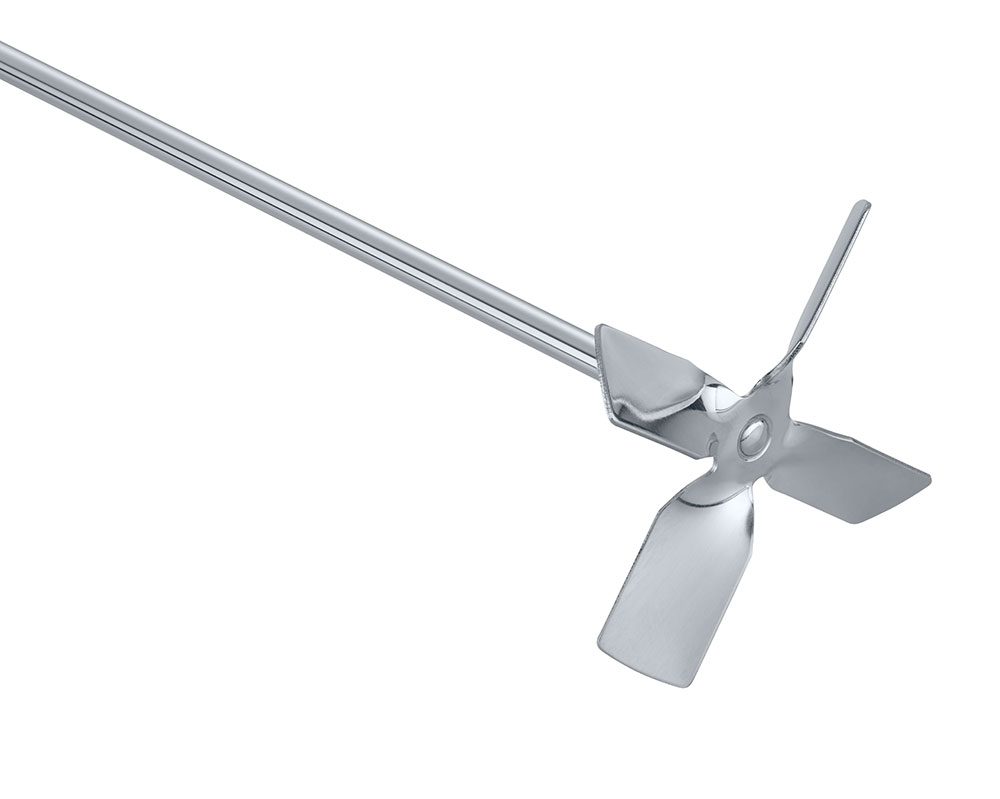
For a low-to-medium viscosity slurry where the primary task is suspending dense solids and renewing the diffusion boundary layer, an axial-flow impeller is the correct choice. A 3-blade propeller (IKA R 1385) operating at 300 rpm in a baffled or sufficiently tall vessel will function well, while keeping shear low enough that the porous roasted-product particles are not unnecessarily fragmented. If a higher solid loading or a more cohesive slurry is anticipated, a paddle stirrer (R 1375) or a dissolving disc (R 1300) can be substituted.Why a True-Torque Digital Stirrer Matters for Research Reproducibility
Reproducing a published process at 300 rpm is not enough on its own; the slurry must actually be homogeneous at that setpoint. A digital overhead stirrer with a brushless DC motor and real-time torque display lets the researcher confirm in real time that the impeller is loaded appropriately, that no settling has occurred (which would cause a sudden torque spike), and that scale-up to a larger vessel maintains the same specific power input (P/V). This level of process control is what separates a defensible publication-quality experiment from a non-reproducible one.* Figure 1 : An experimental flowchart of the complex salt roasting–water leaching process for lithium extraction from lepidolite.
Conclusion and Solution
The Gu et al. process is a compelling demonstration that lepidolite can deliver lithium, rubidium, and cesium simultaneously at recoveries above 82% for all three elements, with lithium recovery approaching 95%. As laboratories worldwide stand up similar critical-minerals programs in response to battery, EV, and energy-storage demand, the bottleneck is rarely the chemistry but the reliability of the mechanical agitation that drives the leaching step.IKA's EUROSTAR series of digital overhead stirrers is purpose-built for exactly this duty:
• Maintenance-free brushless DC motor — no carbon-brush wear in long-duration leaching runs
• True torque display — confirm slurry homogeneity in real time and flag settling or thickening
• Wide speed range (30–2000 rpm on EUROSTAR 60 digital; 30–600 rpm on EUROSTAR 100 digital) — covers gentle suspension through aggressive mass-transfer duty
• Sealed housing — resistant to acid mist and salt aerosols that are routine in hydrometallurgy
• Full IKA R 13xx impeller ecosystem — propellers, dissolving discs, anchors, and tangential-style stirrers for any slurry rheology
For laboratories building out a lepidolite-to-lithium workflow or any analogous slurry-leaching workflow for spodumene, zinnwaldite, or recycled black-mass material, IKA provides the complete benchtop solution: an EUROSTAR digital overhead stirrer, the matched R 13xx impeller, an R 2722 and R 2723 series stand for heavy-duty mounting, and an HRC 2 circulator to hold the 60 °C leaching temperature precisely.
Find more information on the full IKA overhead stirrer range and accessories at www.ika.com or contact your IKA product specialist to discuss a configuration tailored to your critical-minerals research program.
* Reference
- Gu, J.; Liang, B.; Luo, X.; Yuan, W.; Xiao, B.; Tang, X. Systematic Optimization of Complex Salt Roasting and Leaching Conditions for Efficient Extraction of Lithium, Rubidium and Cesium from Lepidolite. Molecules 2025, 30, 2244. click
RELATED CONTENT
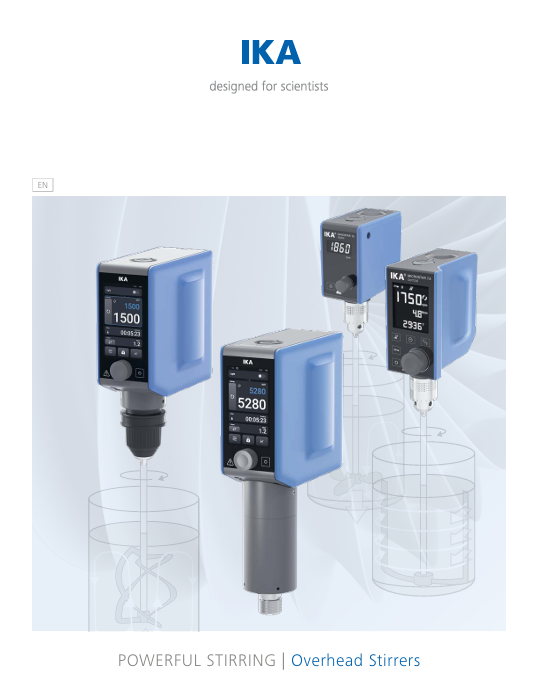 Overhead Stirrers |
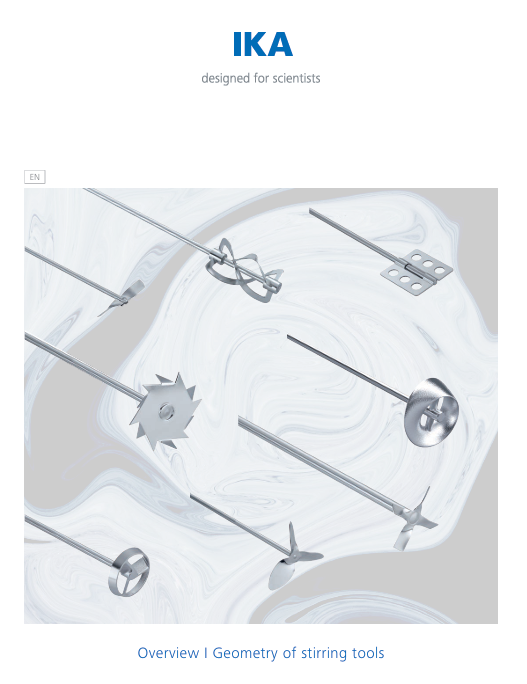 Geometry of stirring tools |
VIDEO
EUROSTAR Overhead Stirrer series
Related Products
 R290
R290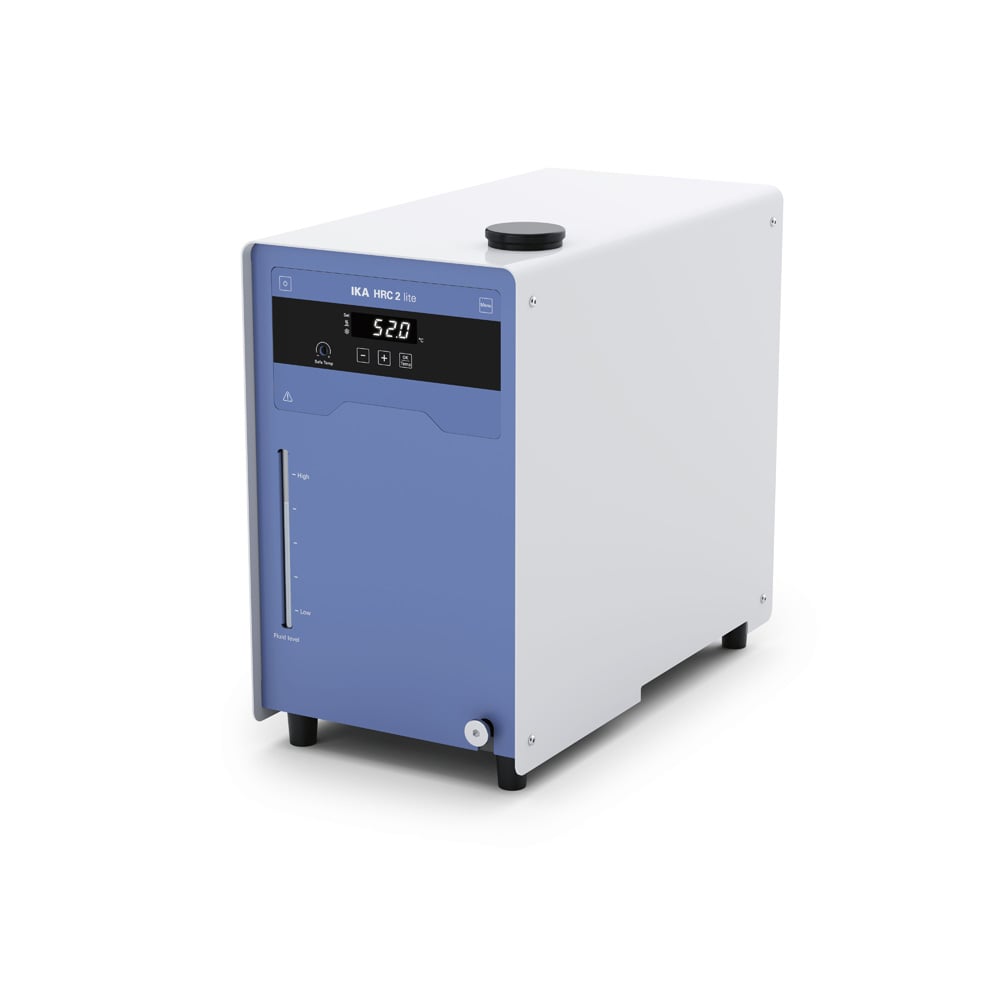
If you have any questions or wish to receive a personal quotation, please contact our sales team
请联系我们
< Back to Blog overview请联系我们