
< Back to Blog overview

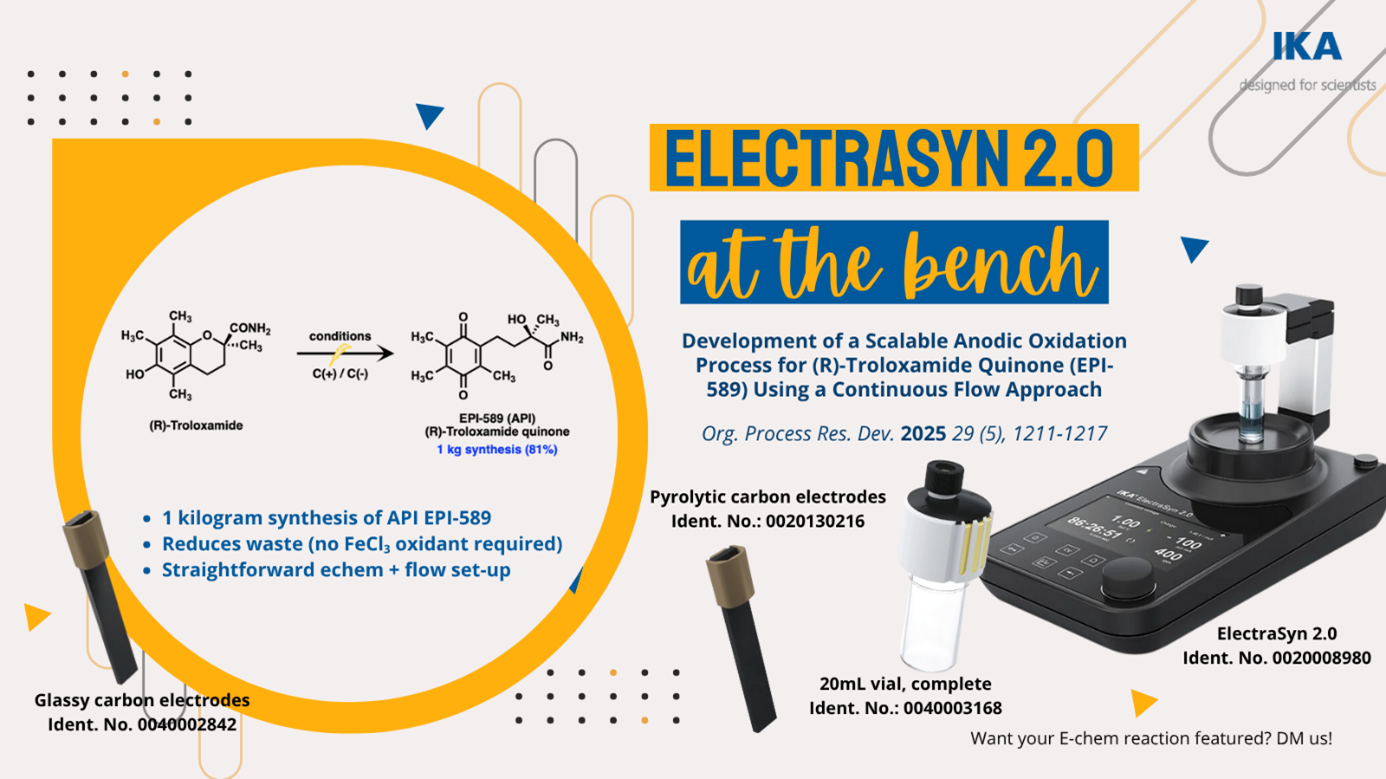
This article addresses the limitations of traditional oxidation methods by implementing a paired electrochemical oxidation strategy that replaces chemical oxidants with electric current as the reagent. Using a benchtop ElectraSyn platform, the researchers optimized conditions for selective anodic oxidation of the precursor alcohol to EPI-589, achieving high yields with minimal waste.
The true breakthrough lies in the translation of this reaction to a continuous flow electrochemical system, which offers several advantages:
To overcome these issues, the team first conducted small-scale reaction development using the ElectraSyn platform, a compact benchtop electrochemical reactor ideal for early-stage experimentation. This setup enabled rapid screening and optimization of conditions using paired electrolysis, with a platinum anode and a glassy carbon cathode. The reaction used electricity as the oxidant, providing a clean, selective, and high-yield transformation of the alcohol precursor into EPI-589. Importantly, this early work demonstrated the feasibility of replacing hazardous chemical oxidants with a greener, electrochemical approach.
Once optimal conditions were established on the millimole scale, the process was successfully translated to a continuous flow electrochemical reactor—a system well-suited for controlled scale-up. The flow setup enabled precise tuning of reaction parameters such as current density, flow rate, and residence time. This facilitated kilogram-scale production of EPI-589 with excellent reproducibility and consistent product quality.
By leveraging ElectraSyn for early-stage development and transitioning to flow electrochemistry for scale-up, this project highlights a practical and sustainable route from lab discovery to manufacturing. The approach eliminates stoichiometric oxidants, minimizes waste, and offers a scalable path forward for electrochemical API synthesis.
This achievement underscores the growing potential of modular electrosynthesis tools like ElectraSyn to bridge bench chemistry with industrial application, reinforcing the broader role of green electrochemical technologies in future pharmaceutical development.
The full potential of Electrosynthesis
Related Products
Development of a Scalable Anodic Oxidation Process for (R)- e (EPI-589) Using a Continuous Flow Approach
Application and Importance of the Reaction
(R)-Troloxamide Quinone (EPI-589) is a small molecule with significant therapeutic potential, particularly in the treatment of neurodegenerative diseases such as ALS and Parkinson’s disease. Its mechanism of action as a redox-active compound supports mitochondrial function and oxidative stress management, making it a valuable candidate for advancing clinical therapies. As interest in EPI-589 grows, the demand for efficient, sustainable, and scalable synthetic routes becomes increasingly important—not only to enable preclinical and clinical studies but also to support future commercial supply. The development of a clean, high-yield electrochemical oxidation route addresses this critical need, laying the groundwork for more environmentally responsible pharmaceutical production processes.Previous Methods and Their Challengess
Historically, the synthesis of EPI-589 has relied on stoichiometric chemical oxidants, such as manganese dioxide, chromium(VI) reagents, or hypervalent iodine species. While effective on small scale, these oxidants pose several challenges:- Environmental impact: They generate large quantities of hazardous waste, which require costly and energy-intensive disposal.
- Limited scalability: Batch reactions involving solid oxidants often suffer from inconsistent mixing and heat transfer, complicating scale-up efforts.
- Safety concerns: Many of these oxidants are toxic, corrosive, or unstable, increasing operational risks.
- Reproducibility issues: Sensitive reaction conditions and batch-to-batch variability hinder consistent product quality at larger scales.
Proposed Approach to Address the Challenges
This article addresses the limitations of traditional oxidation methods by implementing a paired electrochemical oxidation strategy that replaces chemical oxidants with electric current as the reagent. Using a benchtop ElectraSyn platform, the researchers optimized conditions for selective anodic oxidation of the precursor alcohol to EPI-589, achieving high yields with minimal waste.
The true breakthrough lies in the translation of this reaction to a continuous flow electrochemical system, which offers several advantages:
- Scalability: The modular flow setup allows for kilogram-scale synthesis with consistent quality.
- Efficiency: Flow electrochemistry ensures precise control over reaction time, temperature, and electrode surface area, resulting in excellent reproducibility.
- Sustainability: The method eliminates the need for stoichiometric oxidants, drastically reducing environmental impact.
- Safety: Continuous flow systems are inherently safer, especially for reactions involving electricity or reactive intermediates.
Methodology
In a major stride toward sustainable pharmaceutical manufacturing, researchers have developed a scalable anodic oxidation process for synthesizing (R)-Troloxamide Quinone (EPI-589), a redox-active compound with promising neuroprotective properties. Traditional oxidation methods for this molecule rely on stoichiometric chemical oxidants—approaches that generate significant waste and present major barriers to safe, reproducible scale-up.To overcome these issues, the team first conducted small-scale reaction development using the ElectraSyn platform, a compact benchtop electrochemical reactor ideal for early-stage experimentation. This setup enabled rapid screening and optimization of conditions using paired electrolysis, with a platinum anode and a glassy carbon cathode. The reaction used electricity as the oxidant, providing a clean, selective, and high-yield transformation of the alcohol precursor into EPI-589. Importantly, this early work demonstrated the feasibility of replacing hazardous chemical oxidants with a greener, electrochemical approach.
Once optimal conditions were established on the millimole scale, the process was successfully translated to a continuous flow electrochemical reactor—a system well-suited for controlled scale-up. The flow setup enabled precise tuning of reaction parameters such as current density, flow rate, and residence time. This facilitated kilogram-scale production of EPI-589 with excellent reproducibility and consistent product quality.
By leveraging ElectraSyn for early-stage development and transitioning to flow electrochemistry for scale-up, this project highlights a practical and sustainable route from lab discovery to manufacturing. The approach eliminates stoichiometric oxidants, minimizes waste, and offers a scalable path forward for electrochemical API synthesis.
This achievement underscores the growing potential of modular electrosynthesis tools like ElectraSyn to bridge bench chemistry with industrial application, reinforcing the broader role of green electrochemical technologies in future pharmaceutical development.
RELATED CONTENT
The full potential of Electrosynthesis
VIDEO

Related Products
If you have any questions or wish to receive a personal quotation, please contact our sales team
请联系我们
< Back to Blog overview请联系我们